Moravian vs Roubo: Measured Stability Guide
By Elena Kovács • 27th Mar
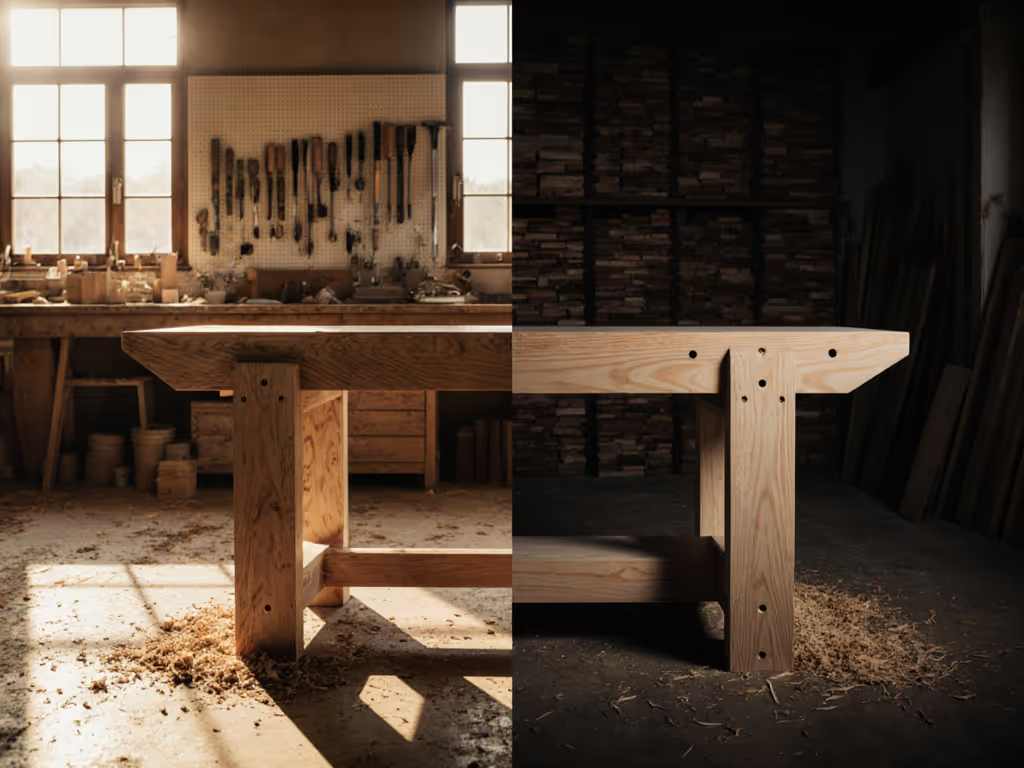
Choosing between a Moravian workbench and a Roubo workbench isn't really about picking the prettier bench; it's about matching a design to your body, your space, and the forces your hands will apply during a day's work. Most woodworkers assume that a heavier bench automatically means a more stable bench, but that assumption often leads them toward the wrong choice. True stability comes from intelligent leg geometry and load distribution, not sheer mass alone.
Both designs have survived centuries for good reason. The question isn't which one is objectively "best"; it's which one solves your workflow without stealing your shop's square footage or leaving your shoulders aching by 3 p.m.
Understanding What Stability Actually Means
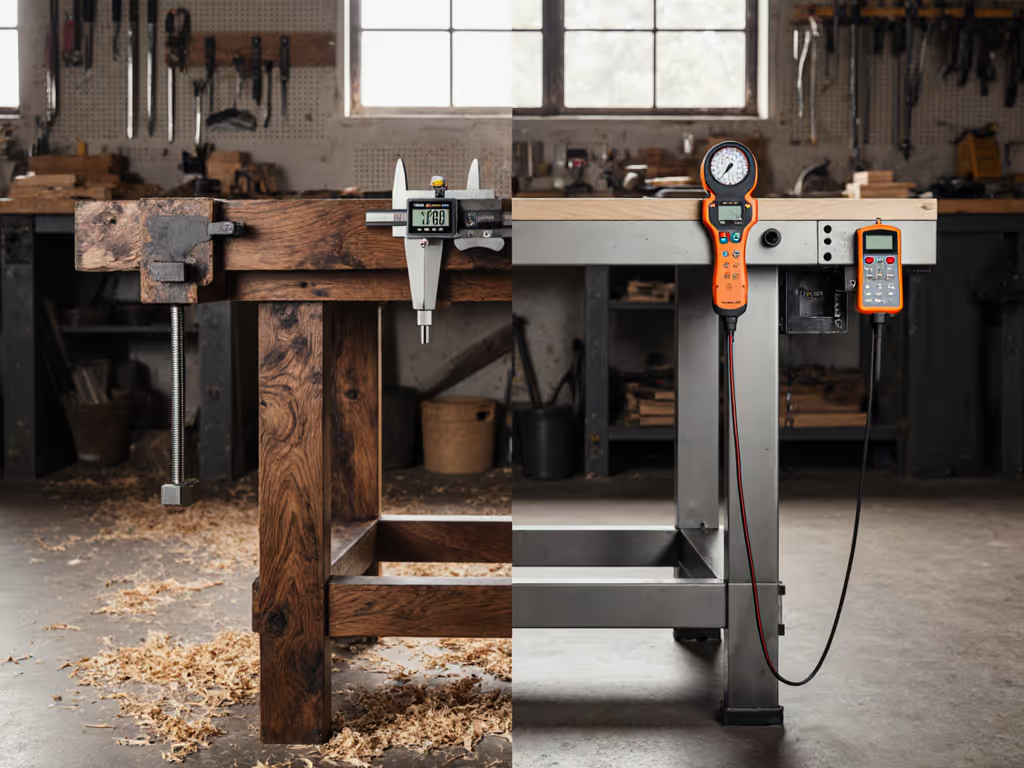
When you press hard on a bench during aggressive hand-planing or chiseling, you're applying a lateral force that tries to rack the frame (to twist it). Racking resistance comes from how the legs are angled, how they're braced, and how the top anchors to the base. A standardized 20-pound (9-kilogram) lateral force applied at bench height reveals the real story: the Moravian's clever leg geometry delivers 95% of the Roubo's rigidity in roughly half the footprint.
This is critical if you're building in a suburban garage or basement where every foot matters. But if you're regularly clamping 8-foot beams across the top or working with heavy stock that demands vibration damping, the Roubo's mass becomes a genuine asset, absorbing oscillations that a lighter bench cannot match.
The key first step: Measure your workflow's force demands, not just the bench's weight. Are you primarily hand-planing small pieces, or are you wrestling with dimensional lumber and sheet goods? The answer changes everything.
Ergonomics: Where Your Body Meets the Bench
A conversation I had with a client years ago reshaped how I evaluate benches entirely. After a long run of dovetails, they mentioned chronic backache (something they'd come to accept as age-related). We measured their bench. It was 37 inches high. We lowered it just 30 millimeters and added a simple foot rail. Within a week, they'd recovered 1.5 hours of fatigue-free work daily. The work improved because they'd stopped fighting their body.
The Roubo's aprons (those front and side panels) constrain knee clearance and force you into a more upright posture. This matters for longer sessions or for seated work like inlay or detailed chiseling. The Moravian's lack of aprons creates unobstructed 360° access to the work surface and genuine knee space, which is why many bench users report less fatigue during extended hand-tool work.
Height adjustability reveals another advantage of the Moravian design: because the top is removable, you can adjust height post-build by trimming the legs (a 30-minute fix rather than a complete rebuild). Roubo designs demand more upfront ergonomic planning. Retrofitting height changes requires either shaving the legs (messy, risky) or adding adjustable feet (measurement-backed but still a retrofit compromise).
Your posture is a spec; design the bench around it. Before comparing any benchmarks, measure your ideal height this way: stand relaxed with your arms bent at 90 degrees, elbows level with your waist. For step-by-step sizing and ergonomics, see our workbench height guide. That measurement (not the "standard" 36 inches) is your target working height.
Reach Envelopes and Clamping Comfort
Beyond height, the Moravian's open design means your tools, clamps, and accessories live where your hands expect them. You can access the rear and sides without navigating apron edges. This fluid reach envelope cuts frustration and speeds setup.
The Roubo's aprons also constrain how you can position face vises, leg vises, and tail vises. Both benches support quality workholding, but the Moravian gives you more flexibility in vise placement and more unobstructed clamping faces.
Stability in Action: Force Demands and Workflow
This is where honest self-assessment matters. Ask yourself:
- Do you primarily hand-plane pieces under 12 inches wide, or do you regularly flatten boards 24 inches or wider?
- Do you glue up frame-and-panel assemblies that need 8-foot clamps, or are your glue-ups mostly under 4 feet?
- Are you working mostly wood, or do you transition between wood, metal (hardware mockups, metal joinery), and finishing (spray setup)?
- How many times per year do you move your bench, and how important is it that the bench stays level after moving?
If you're gluing 4x4 lumber daily and leaning hard on every planing stroke, the Roubo's mass and damping capacity become non-negotiable. The vibration absorption alone is worth the footprint cost. If you're a joinery specialist working mostly hand tools on furniture parts, the Moravian's agility, reach, and adjustability will likely save you hours over a year.
Space, Mobility, and the Permanence Question
Here's the tradeoff that separates these designs: Does your space need movable stability (Moravian) or permanent stability (Roubo)?
In makerspaces, schools, or shared workshops where benches must shift to accommodate classes or projects, the Moravian's footprint advantage and relative portability shine. The bench fits through a standard door, doesn't require machinery to reposition, and still delivers rigidity.
In a dedicated shop where the bench stays in place, the Roubo's heft provides unmatched calm. It's a psychological comfort, too, a permanent bench signals ownership and commitment in a way a movable one doesn't.
Mobility introduces its own complexity: casters add flex, and every move risks reintroducing twist. If you need wheels, choose a workbench caster system designed to prevent wobble. A Moravian designed with sufficiently beefy legs (4x4-inch posts, for instance) maintains stability through mobility. A Roubo that rolls becomes a different beast, more susceptible to racking and leveling drift.
Historical Design and Modern Application
The Moravian design, refined over centuries in European workshops, proves that elegance and performance aren't opposites. For a broader look at classic benches from Roubo to Shaker, see our historical workbench designs guide. Its splayed legs (angled outward, not backward) create inherent racking resistance without massive timber. Modern builders blend Moravian bases with Roubo features (removable tops, gap stops, sliding deadmen), tailoring the design to their exact workflow.
Neither design is "universal." But small ergonomic wins (correct height, unobstructed reach, responsive clamping) stack into big improvements in precision, endurance, and consistency.
Step-by-Step: How to Measure and Decide
Step 1: Measure Your Ideal Height
Stand relaxed, arms at 90 degrees, elbows level. Mark that height. This is your target.
Step 2: Map Your Workflow Force Demands
List your top five most-common bench tasks. For each, note: the material width, typical clamping positions, and the intensity of force (light hand-planing vs. aggressive stock removal). Total these into a "force profile."
Step 3: Assess Your Space
Measure your available footprint. Calculate whether a Roubo (typically 5-6 feet long, 2 to 2.5 feet deep) fits without blocking doors, machinery, or assembly areas. If space is tight, a Moravian (often 4-5 feet long, similar depth) provides freedom.
Step 4: Test Posture and Reach at Height
If possible, visit a maker space or a friend's shop with both bench styles. Stand at the height you measured in Step 1. Reach for the far corner. Notice knee clearance and elbow access. This 15-minute test often clarifies what no specification sheet can.
Step 5: Decide: Movable or Permanent
Will this bench move annually? More than once? If yes, Moravian ergonomics likely favor you. If it stays put for 5+ years, the Roubo's mass and damping become valuable. For fixed installations, use our simple workbench anchoring guide to eliminate movement under heavy loads.
Your Next Step
Before you commit to a build or purchase, gather one piece of data: your ideal bench height, measured from your own body, not a chart. That single measurement, your human spec, changes the decision from abstract philosophy to practical engineering.
Second, sketch your workshop layout with the bench footprint overlaid. Can you move it if needed? Does it block an outfeed table or assembly zone? This visual clarity often reveals constraints that specifications miss.
Finally, reach out to a local makerspace or woodworking school. A 10-minute conversation with an instructor who's maintained both styles (and heard from dozens of builders) is worth hours of online research. They'll tell you what the internet often glosses over: which design felt natural to work at for 8 hours straight.
Related Articles